给定一个字符串描述的算术表达式,计算出结果值。
输入字符串长度不超过 100 ,合法的字符包括 ”+, -, *, /, (, )” , ”0-9” 。
数据范围:运算过程中和最终结果均满足 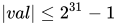 ,即只进行整型运算,确保输入的表达式合法
import java.util.Scanner;
import java.util.Stack;


public class Main {
    public static void main(String[] args) {
        Scanner in = new Scanner(System.in);
        String expression = in.nextLine();
        Stack<Character> s1 = new Stack<>();
        Stack<String> s2 = new Stack<>();
        String number = "";
        // 遍历表达式的每个字符,将中缀转化成后缀表达式
        for (int i = 0; i < expression.length(); i++) {
            if (isOperator(expression.charAt(i), i, expression)) {
                while (!s1.isEmpty() && s1.peek() != '(' &&
                        priorityCompare(s1.peek(), expression.charAt(i)) >= 0) {
                    s2.add(String.valueOf(s1.pop()));
                }
                s1.add(expression.charAt(i));
            } else if (expression.charAt(i) == '(') {
                s1.add(expression.charAt(i));
            } else if (expression.charAt(i) == ')') {
                while (s1.peek() != '(') {
                    s2.add(String.valueOf(s1.pop()));
                }
                s1.pop();
            } else if (Character.isDigit(expression.charAt(i))
                       || (expression.charAt(i) == '-' && (i == 0 ||
                               isNegativeNumberStart(i, expression)))) {
                // 当前字符是数字或者负号时
                number = String.valueOf(expression.charAt(i));
                for (int j = i + 1; j < expression.length(); j++) {
                    if (!Character.isDigit(expression.charAt(j))) {
                        break;
                    }
                    number = number + String.valueOf(expression.charAt(j));
                    i++;
                }
                s2.add(number);
            }
        }
        while (!s1.isEmpty()) {
            s2.add(String.valueOf(s1.pop()));
        }
        // 此时s2里就是我们已经转化好的后缀表达式,但是由于要从栈尾开始遍历,但栈只能从栈顶开始遍历,
        // 所以这里再遍历s2换到新的栈s3,此时s3的栈顶就是s2的栈尾,正常遍历s3就可以了(当然也可以使用双端栈就不用这么麻烦了)
        Stack<String> s3 = new Stack<>();
        while (!s2.isEmpty()) {
            s3.add(s2.pop());
        }
        Stack<Integer> s4 = new Stack<>();
        while (!s3.isEmpty()) {
            // 如果当前元素长度大于1,则必定是数字,比如负数-1 或 多位数11
            // 如果当前元素长度是1且isDigit==true,必定是数字
            if (s3.peek().length() > 1 || (s3.peek().length() == 1 &&
                                           Character.isDigit(s3.peek().charAt(0)))) {

                s4.add(Integer.parseInt(s3.pop()));
            } else {
                // 如果遇到运算符,则弹出栈里前两位元素进行运算
                s4.add(calculate(s4.pop(), s4.pop(), s3.pop().charAt(0)));
            }
        }
        System.out.println(s4.peek());
    }
    // 比较运算符的优先级
    public static int priorityCompare(char before, char after) {
        if (before == '+' || before == '-') {
            if (after == '*' || after == '/') {
                return -1;
            }
        } else if (before == '*' || before == '/') {
            if (after == '+' || after == '-') {
                return 1;
            }
        }
        return 0;
    }
    // 判断当前字符是否为运算符
    public static boolean isOperator(char c, int index, String expr) {
        if (c == '+' || c == '*' || c == '/') {
            return true;
        }
        // 如果是-,且不是首位,且不是负号,则说明是减号
        if (c == '-' && (index > 0 && !isNegativeNumberStart(index, expr))) {
            return true;
        }
        return false;
    }

    /**
     * 判断当前-字符是否为负号
     * @param index 当前字符的下标
     * @param expr 表达式
     * @return
     */
    public static boolean isNegativeNumberStart(int index, String expr) {
        // 如果-在首位,那么必定是负号而不是减号
        if (index == 0) {
            return true;
        }
        // 既然不是首位,那么获取前一位的字符
        char prevChar = expr.charAt(index - 1);
        // 如果前一位是以下字符则说明是负号而不是减号
        // 比如:1+(-1)、1+-1、1--1、1*-1、1/-1 这些都是负号前一位字符的特征
        return prevChar == '(' || prevChar == '+' || prevChar == '-' ||
               prevChar == '*' || prevChar == '/';
    }
    // 计算
    public static int calculate(int first, int second, char operator) {
        int result = 0;
        switch (operator) {
            case '+':
                result = first + second;
                break;
            case '-':
                // 注意这里是后一位 减去 前一位
                result = second - first;
                break;
            case '*':
                result = first * second;
                break;
            case '/':
                // 注意这里是后一位 除以 前一位
                result = second / first;
                break;
        }
        return result;
    }
} 
import java.util.*;
import javax.script.*;
// 注意类名必须为 Main, 不要有任何 package xxx 信息
public class Main {
    public static void main(String[] args) throws Exception {
        Scanner scan = new  Scanner(System.in);
        String input = scan.nextLine();
        ScriptEngine scriptEngine = new ScriptEngineManager().getEngineByName("nashorn");
        System.out.println(scriptEngine.eval(input));
    }
} 给定一个字符串描述的算术表达式,计算出结果值。
输入算术表达式
计算出结果值
400+5复制
405
import java.util.*;

// 注意类名必须为 Main, 不要有任何 package xxx 信息
public class Main {
    /**
    无视左括号
    将操作数压入操作数栈
    将运算符压入运算符栈
    在遇到右括号的时候,从运算符栈中弹出一个运算符,再从操作数栈中弹出所需的操作数,
    并且将运算结果压入操作数栈中
    */
    public static void main(String[] args) {
        Scanner in = new Scanner(System.in);
        Stack<Integer> s1 = new Stack<>(); //操作数栈
        Stack<Character> s2 = new Stack<>(); //运算符栈
        // 注意 hasNext 和 hasNextLine 的区别
        while (in.hasNextLine()) { // 注意 while 处理多个 case
            String str = in.nextLine();
            int len = str.length();
            String tem = "";
            for(int i=0; i<len; i++) {
                char ch = str.charAt(i);
                switch(ch) {
                    case '(':
                    case '[':
                    case '{':
                        break; //忽略
                    case '+':
                    case '-':
                    case '*':
                    case '/':
                        s2.push(ch);//操作符入栈
                        break;
                    case ')':
                    case ']':
                    case '}':
                        //计算,并将操作数重新入栈
                        //1.弹出操作符
                        //2.弹出操作数1
                        //3.弹出操作数2
                        //计算,并将结果重新放到操作数栈
                        char flag = s2.pop();
                        Integer num1 = s1.pop();
                        Integer num2 = s1.pop();
                        Integer sum = null;
                        switch(flag) {
                            case '+':
                                sum = num1 + num2;
                                s1.push(sum);
                                break;
                            case '-':
                                sum = num1 - num2;
                                s1.push(sum);
                                break;
                            case '*':
                                sum = num1 * num2;
                                s1.push(sum);
                                break;
                            case '/':
                                sum = num1 / num2;
                                s1.push(sum);
                                break;
                        }
                        break;
                    default:
                        tem += String.valueOf(ch);
                        if(!nextIsNotNum(str, i, len)) {
                            s1.push(Integer.parseInt(tem));
                            tem = "";
                        }
                        break;
                }
            }
            //统计并输出
            int res = 0;
            while(!s1.isEmpty()) {
                res += s1.pop();
            }
            System.out.println(res);
        }
    }
    public static boolean nextIsNotNum(String str, int n, int len) {
        int temp = -1;
        try {
            temp = Integer.parseInt(String.valueOf(str.charAt(n+1)));
        } catch(Exception e) {
            temp = -1;
        }
        return temp != -1;
    }
} package com.ihang.learn.java.huawei;
import java.util.Deque;
import java.util.LinkedList;
import java.util.Scanner;
import java.util.Stack;
/**
* @author yaohangyang
* @date 2022/11/7
*/
public class HJ54 {
public static void main(String[] args) {
Scanner in = new Scanner(System.in);
// 注意 hasNext 和 hasNextLine 的区别
while (in.hasNextLine()) {
// 注意 while 处理多个 case
System.out.println(hj54(in.nextLine()));
}
}
//中缀表达式转后缀表达式
public static Deque<String> Mid2End(String str) {
//用于存运算数
StringBuilder number = new StringBuilder();
//后缀表达式
Deque<String> deque = new LinkedList<>();
//运算操作符
Stack<Character> stack = new Stack<>();
boolean flag = false;
for(int i = 0; i<str.length(); i++){
char c = str.charAt(i);
if(c>='0' && c<='9'){
number.append(c);
}else {
if(number.length()>0){
if(flag){
deque.add("-"+number.toString());
flag = false;
}else {
deque.add(number.toString());
}
number.delete(0,number.length());
}
if(c=='('){
stack.push(c);
}else if(c==')'){
char top = stack.peek();
while (top!='('){
deque.add(stack.pop()+"");
top = stack.peek();
}
stack.pop();
}else if(c=='-' && (i==0 || str.charAt(i-1)=='(')){
// 用于处理运算数是负数的情况 比如:-1*(-1-1) => -1 -1 1 - *
flag = true;
}else {
if(stack.size()<=0 || stack.peek()=='(' || opeCompare(c,stack.peek())){
stack.push(c);
}else {
while (stack.size()>0 && stack.peek()!='(' && !opeCompare(c,stack.peek())){
deque.add(stack.pop()+"");
}
stack.push(c);
}
}
}
}
if(number.length()>0){
deque.add(number.toString());
}
while (stack.size()>0){
deque.add(stack.pop()+"");
}
return deque;
}
//运算符优先级比较
public static boolean opeCompare(char a ,char b){
if(a=='*' || a=='/'){
if(b=='+' || b=='-'){
return true;
}
}
return false;
}
//后缀表达式计算
public static int hj54(String str){
Deque<String> deque = Mid2End(str);
Stack<Integer> stack = new Stack<>();
while (deque.size()>0){
String s = deque.pollFirst();
if(s.charAt(s.length()-1)>='0' && s.charAt(s.length()-1)<='9'){
stack.push(Integer.parseInt(s));
}else {
int b = stack.pop();
int a = stack.pop();
int r = 0;
switch (s.charAt(0)){
case '*':
r = a*b;
break;
case '/':
r = a/b;
break;
case '+':
r = a+b;
break;
case '-':
r = a-b;
break;
default:
break;
}
stack.push(r);
}
}
return stack.pop();
}
}
import java.io.IOException;
import java.io.InputStreamReader;
import java.io.BufferedReader;
import java.util.Stack;
public class Main {
    public static void main(String[] args) throws IOException {
        BufferedReader br = new BufferedReader(new InputStreamReader(System.in));
        String line = br.readLine();
        System.out.println(calculate(line));
    }
    public static int calculate(String line){
        Stack<Integer> stack = new Stack<>();
        char sign = '+';
        int number = 0;
        int len = line.length();
        char[] chars = line.toCharArray();
        for(int i = 0; i < len; i++){
            char ch = chars[i];
            if(ch == ' ')continue;
            if(Character.isDigit(ch)){
                number = number * 10 + ch - '0';
            }
            if(ch == '('){
                int count = 1;
                int j = i + 1;
                while(count > 0){
                    if(chars[j] == ')')count--;
                    if(chars[j] == '(')count++;
                    j++;
                }
                //递归,解小括号中的表达式
                number = calculate(line.substring(i + 1, j - 1));
                i = j - 1;
            }
            if(!Character.isDigit(ch) || i == len - 1){
                if(sign == '+'){
                    stack.push(number);
                }else if(sign == '-'){
                    stack.push(-1 *number);
                }else if(sign =='*'){
                    stack.push(stack.pop() * number);
                }else if(sign == '/'){
                    stack.push(stack.pop() / number);
                }
                //更新符号
                sign = ch;
                //刷新数字
                number = 0;
            }
        }
        //栈中数字求和得到结果
        int ans = 0;
        while (!stack.isEmpty()) {
            ans += stack.pop();
        }
        return ans;
    }
} import java.io.IOException;
import java.io.InputStream;
import java.util.Scanner;
import java.util.Stack;
public class Main {
public static void main(String[] args) throws IOException {
InputStream in = System.in;
Scanner scanner = new Scanner(in);
String str = scanner.nextLine();
int result = getEvaluation(str);
System.out.println(result);
}
private static int getEvaluation(String str) {
if (str == null || str.length() == 0) return 0;
// 记录数值
Stack<Integer> arithmetic = new Stack<>();
// 记录运算符
Stack<Character> operator = new Stack<>();
int i = 0;
while(i < str.length()) {
// 对负数的判断
boolean negative = false;
if ((str.charAt(i) == '-' && arithmetic.isEmpty()) ||
(str.charAt(i) == '-' && !(str.charAt(i-1) >= '0' && str.charAt(i-1) <= '9') && str.charAt(i-1) != ')')) {
negative = true;
i++;
}
// 保存数值
if (i < str.length() && str.charAt(i) >= '0' && str.charAt(i) <= '9'){
StringBuilder builder = new StringBuilder();
while (i < str.length() && str.charAt(i) >= '0' && str.charAt(i) <= '9'){
builder.append(str.charAt(i));
i++;
}
arithmetic.push(negative ? -Integer.valueOf(builder.toString()) : Integer.valueOf(builder.toString()));
}
// 出栈处理数值
if (i < str.length() && (str.charAt(i) == '+' || str.charAt(i) == '-')) {
while (!operator.isEmpty() && (operator.peek() == '*' || operator.peek() == '/')) {
Character op = operator.pop();
Integer n1 = arithmetic.pop();
Integer n2 = arithmetic.pop();
arithmetic.push(operation(n2, n1, op));
}
while (!operator.isEmpty() && (operator.peek() == '+' || operator.peek() == '-')){
Character op = operator.pop();
Integer n1 = arithmetic.pop();
Integer n2 = arithmetic.pop();
arithmetic.push(operation(n2, n1, op));
}
operator.push(str.charAt(i));
i++;
}
// 遇到右括号再出栈处理
else if (i < str.length() && (str.charAt(i) == ')')){
while (true){
Character op = operator.pop();
if (op == '(') break;
Integer n1 = arithmetic.pop();
Integer n2 = arithmetic.pop();
arithmetic.push(operation(n2,n1,op));
}
i++;
}
// 其他情况运算符入栈即可
else{
if (i == str.length())
break;
operator.push(str.charAt(i));
i++;
}
}
while (!operator.isEmpty()){
Character op = operator.pop();
Integer n1 = arithmetic.pop();
Integer n2 = arithmetic.pop();
arithmetic.push(operation(n2,n1,op));
}
return arithmetic.pop();
}
/**
* 基础运算
*/
private static Integer operation(Integer n1, Integer n2, Character op) {
if (op == '+')
return n1 + n2;
else if (op == '-')
return n1 - n2;
else if (op == '*')
return n1 * n2;
else
return n1 / n2;
}
} 
扫描二维码,关注牛客网

下载牛客APP,随时随地刷题

扫一扫,把题目装进口袋

扫描二维码,进入QQ群

扫描二维码,关注牛客公众号
 京公网安备
11010502036488号
京公网安备
11010502036488号


