一个有 n 户人家的村庄,有 m 条路相互连接着。村里现在要修路,每条路都有一个成本价格,现在请你帮忙计算下,最少需要花费多少钱,就能让这 n 户人家连接起来。
每户之间可能有多条道路连接,但不可能自己与自己相连。
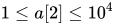
数据范围:  ,
,  ,
, 
进阶: 时间复杂度 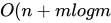) , 空间复杂度
, 空间复杂度 )
3,3,[[1,3,3],[1,2,1],[2,3,1]]
2
2,1,[[1,2,1]]
1
为什么prim算法通过不了,只能过前六个测试,不知道问题出哪里了public int miniSpanningTree(int n, int m, int[][] cost) { int[][] graph = new int[n][n]; //构建邻接矩阵图 for (int i = 0; i < m; i++) { int u = cost[i][0] - 1; int v = cost[i][1] - 1; int weight = cost[i][2]; graph[u][v] = weight; graph[v][u] = weight; } if (n == 2) return cost[0][2]; // write code here //status数组记录节点是否联通了,初始化都为false boolean[] status = new boolean[n]; Arrays.fill(status, false); //distance数组记录各个点到联通部分的最短距离,初始化无穷 int[] dist = new int[n]; Arrays.fill(dist, Integer.MAX_VALUE); //pre数组记录节点和谁联通,初始化都为-1 int[] pre = new int[n]; Arrays.fill(pre, -1); //开始遍历,n个点需要遍历n-1次,从点0(下标)开始 dist[0] = 0; int totalCost = 0; for (int i = 0; i < n; i++) {//循环次数为点的个数,因为每个点都要加入mst // 选择键值最小的顶点u,它尚未包含在MST中 int u = -1;//初始化该点为不连通(可能没必要?) int max = Integer.MAX_VALUE;//初始化一个值为整型最大值来循环排除无穷不可达 for (int j = 0; j < n; j++) { if (!status[j] && dist[j] < max) { max = dist[j];//这里不能忘记更新 u = j; } } //找到相应点,添加到集合 if (u == -1) break; status[u] = true; totalCost += dist[u]; for (int v = 0; v < n; v++) { if (!status[v] && graph[u][v] != 0 && graph[u][v] < dist[v]) { pre[v] = u; dist[v] = graph[u][v]; } } } return totalCost; }
import java.util.*;
public class Solution {

    public class bb{
        int from;
        int to;
        int w;
        public bb(int from,int to,int w){
            this.from=from;
            this.to=to;
            this.w=w;
        }
    }
    public int miniSpanningTree (int n, int m, int[][] cost) {
        // write code here
        HashSet<Integer> set=new HashSet<>();
        HashMap<Integer,List<bb>> map=new HashMap<>();
        for(int i=0;i<n;i++){
            List<bb> l=new ArrayList<>();
            map.put(i+1,l);
        }
        PriorityQueue<bb> q=new  PriorityQueue<>(new Comparator<bb>() {
            public int compare(bb o1, bb o2) {
                bb b1=(bb)o1;
                bb b2=(bb)o2;
                return b1.w-b2.w;
            }
        });
        for(int i=0;i<m;i++){
            bb a=new bb(cost[i][0],cost[i][1],cost[i][2]);
            map.get(cost[i][0]).add(a);
            map.get(cost[i][1]).add(a);
        }
        int sum=0;
        set.add(1);
        for(bb b:map.get(1)){
            q.add(b);
        }
        while(!q.isEmpty()){
            bb b=q.poll();
            if((!set.contains(b.from))||(!set.contains(b.to))){
                int d=set.contains(b.from)?b.to:b.from;
                sum+=b.w;
                set.add(d);
                for(bb B:map.get(d)){
                    q.add(B);
                }
            }
        }
        return sum;
    }
} 克鲁斯卡 + 并查集
import java.util.*;


public class Solution {
    /**
     * 代码中的类名、方法名、参数名已经指定,请勿修改,直接返回方法规定的值即可
     *
     * 返回最小的花费代价使得这n户人家连接起来
     * @param n int n户人家的村庄
     * @param m int m条路
     * @param cost int二维数组 一维3个参数,表示连接1个村庄到另外1个村庄的花费的代价
     * @return int
     */
    public int miniSpanningTree (int n, int m, int[][] cost) {
        int minCost = 0;
        UnionFind uf = new UnionFind(n);
        List<int[]> list = new ArrayList<>();
        for (int[] elem : cost) {
            list.add(elem);
        }
        list.sort((o1,o2)->o1[2]-o2[2]);

        for (int[] elem : list) {
            if (uf.find(elem[0]) != uf.find(elem[1])) {
                uf.merge(elem[0],elem[1]);
                minCost+=elem[2];
            }
        }

        return minCost;
    }

    class UnionFind {

        private int N;
        private int[] innerArr;

        public UnionFind(int n) {
            N = n;
            innerArr = new int[N+1];
            init(n);
        }

        /**
         * 并查集初始化
         * 一开始每个节点的父节点都是自己
         * @param n
         */
        private void init(int n) {
            for (int i = 1; i <=N ; i++) {
                innerArr[i]=i;
            }
        }

        /**
         * 查找父节点
         * @param num
         * @return
         */
        public int find(int num) {
            if (innerArr[num]==num) return num;
            //// 方法1:回溯寻找父节点
            //return find(innerArr[num]);

            // 方法2:在递归找寻的时候更新父节点
            // 即让最底层节点直指最顶父节点
            int topFather = find(innerArr[num]);
            innerArr[num] = topFather;
            return topFather;
        }

        /**
         * 合并两个节点所在的集合
         * 即将 num2 的父节点修改为 num1 的父节点
         * @param num1
         * @param num2
         */
        public void merge(int num1,int num2) {
            innerArr[find(num2)] = find(num1);
        }

    }
}
import java.util.*;
public class Solution {
    int[] parent;
    int findParent(int i) {
        if(parent[i] == i) return i;
        parent[i] = findParent(parent[i]);
        return parent[i];
    }
    public int miniSpanningTree (int n, int m, int[][] cost) {
        // write code here
        parent = new int[n + 1];
        for(int i = 0; i <= n; i ++) {
            parent[i] = i;
        }
        Arrays.sort(cost, new Comparator<int[]>(){
            @Override
            public int compare(int[] p1,int[] p2) {
                return p1[2] - p2[2];
            }
        });
        int w = 0;
        for(int i = 0; i < m; i ++) {
            int a = cost[i][0];
            int b = cost[i][1];
            int p1 = findParent(a);
            int p2 = findParent(b);
            if(p1 != p2) {
                w = w + cost[i][2];
                parent[p2] = p1;
            }
        }
        return w;
    }

} import java.util.*;
public class Solution {
/**
* 代码中的类名、方法名、参数名已经指定,请勿修改,直接返回方法规定的值即可
*
* 返回最小的花费代价使得这n户人家连接起来
* @param n int n户人家的村庄
* @param m int m条路
* @param cost int二维数组 一维3个参数,表示连接1个村庄到另外1个村庄的花费的代价
* @return int
*/
public int miniSpanningTree (int n, int m, int[][] cost) {
// write code here
Arrays.sort(cost, (a, b) -> a[2] - b[2]); // 先按边升序排列
UnionFind uf = new UnionFind(n);
int money = 0;
for(int i = 0; i < m; i++){
int from = cost[i][0] - 1;
int to = cost[i][1] - 1;
int costMoney = cost[i][2];
if(!uf.isConnected(from, to)){
uf.union(from, to);
money += costMoney;
}
if(uf.getCount() == 1){
// 所有节点已经连为一体了,退出循环
break;
}
}
return money;
}
}
class UnionFind {
private int[] parent; // 每棵树的根节点
private int[] rank; // 每棵树的相对高度
private int count; // 连通分量数
public UnionFind(int n) {
parent = new int[n];
rank = new int[n];
for(int i = 0; i < n; i++){
parent[i] = i;
rank[i] = 1;
}
}
public int find(int x) {
while(x != parent[x]){
parent[x] = parent[parent[x]];
x = parent[x];
}
return x;
}
public void union(int x, int y) {
int rootX = find(x);
int rootY = find(y);
// 两个节点根不相同时进行合并操作
if(rootX != rootY){
if(rank[rootX] > rank[rootY]){
// x的树比y高,将y合并到x下
parent[rootY] = rootX;
}else if(rank[rootX] < rank[rootY]){
// x的树比y矮,将x合并到y下
parent[rootX] = rootY;
}else{
// 树一样高时合并顺序随意,但是合并另一个子树的树高度要改变
parent[rootX] = rootY;
rank[rootY] ++;
}
}
count--; // 缩减一个分量
}
// 判断两个节点的连通性
public boolean isConnected(int x, int y) {
return find(x) == find(y); // 比较根节点是否相同即可
}
// 返回连通分量数
public int getCount() {
return count;
}
} import java.util.*;
//六刷终于搞懂了:克鲁斯卡尔+并查集
//https://www.bilibili.com/video/BV1g5411c7iS?from=search&seid=5350587815569640429
//https://zhuanlan.zhihu.com/p/93647900
//https://www.bilibili.com/video/BV1Mf4y117bZ?from=search&seid=914796745468480478
//整体思路知道,但是实在没搞清楚find和join的内部实现逻辑
public class Solution {
/**
* 代码中的类名、方法名、参数名已经指定,请勿修改,直接返回方法规定的值即可
*
* 返回最小的花费代价使得这n户人家连接起来
* @param n int n户人家的村庄
* @param m int m条路
* @param cost int二维数组 一维3个参数,表示连接1个村庄到另外1个村庄的花费的代价
* @return int
*/
public int miniSpanningTree (int n, int m, int[][] cost) {
// write code here
//声明和初始化并查集
int[] fa = new int[n+1];
for (int i = 1; i <= n; ++i)fa[i] = i;
int ans = 0;
//几户人家,几!=0,所以从1开始
Arrays.sort(cost, (int[] a, int[] b)-> a[2]-b[2]);
for(int i = 0; i < cost.length; i++) {
if(find(fa, cost[i][0]) != find(fa, cost[i][1])) {
// add edge
join(fa, cost[i][0], cost[i][1]);
ans += cost[i][2];
}
}
return ans;
}
public int find(int[] fa, int x) {
if(fa[x] != x) {
fa[x] = find(fa, fa[x]);
}
return fa[x];
}
public void join(int[] fa, int x, int y) {
int fax = find(fa, x);
int fay = find(fa, y);
fa[fax] = fay;
}
} import java.util.*;
public class Solution {
/**
* 代码中的类名、方法名、参数名已经指定,请勿修改,直接返回方法规定的值即可
*
* 返回最小的花费代价使得这n户人家连接起来
* @param n int n户人家的村庄
* @param m int m条路
* @param cost int二维数组 一维3个参数,表示连接1个村庄到另外1个村庄的花费的代价
* @return int
*/
public int miniSpanningTree (int n, int m, int[][] cost) {
// write code here
int[] fa = new int[n+1];
int ans = 0;
for(int i = 0; i < fa.length; i++) fa[i] = i;
Arrays.sort(cost, (int[] a, int[] b)-> a[2]-b[2]);
for(int i = 0; i < cost.length; i++) {
if(find(fa, cost[i][0]) != find(fa, cost[i][1])) {
// add edge
join(fa, cost[i][0], cost[i][1]);
ans += cost[i][2];
}
}
return ans;
}
public int find(int[] fa, int x) {
if(fa[x] != x) {
fa[x] = find(fa, fa[x]);
}
return fa[x];
}
public void join(int[] fa, int x, int y) {
int fax = find(fa, x);
int fay = find(fa, y);
fa[fax] = fay;
}
} import java.util.*; public class Solution { /** * 代码中的类名、方法名、参数名已经指定,请勿修改,直接返回方法规定的值即可 * * 返回最小的花费代价使得这n户人家连接起来 * @param n int n户人家的村庄 * @param m int m条路 * @param cost int二维数组 一维3个参数,表示连接1个村庄到另外1个村庄的花费的代价 * @return int */ public int miniSpanningTree (int n, int m, int[][] cost) { // write code here Graph graph=createGraph(cost); return KruskalMST(graph); } public class Graph{ HashMap<Integer,Node> nodes; HashSet<Edge> edges; public Graph(){ nodes=new HashMap<>(); edges=new HashSet<>(); } } public class Node{ int value; ArrayList<Node> nexts; ArrayList<Edge> edges; public Node(int value){ this.value=value; nexts=new ArrayList<>(); edges=new ArrayList<>(); } } public class Edge{ int weight; Node from; Node to; public Edge(int weight,Node from,Node to){ this.weight=weight; this.to=to; this.from=from; } } public Graph createGraph(int[][] cost){ Graph graph=new Graph(); for(int i=0;i<cost.length;i++){ int weight=cost[i][2]; int from=cost[i][0]; int to=cost[i][1]; if(!graph.nodes.containsKey(from)){ graph.nodes.put(from,new Node(from)); } if(!graph.nodes.containsKey(to)){ graph.nodes.put(to,new Node(to)); } Node fromNode=graph.nodes.get(from); Node toNode=graph.nodes.get(to); Edge newEdge=new Edge(weight,fromNode,toNode); fromNode.nexts.add(toNode); fromNode.edges.add(newEdge); graph.edges.add(newEdge); } return graph; } public class UnionFind{ HashMap<Node,Node> fatherMap; HashMap<Node,Integer> rankMap; public UnionFind(){ fatherMap=new HashMap<Node,Node>(); rankMap=new HashMap<Node,Integer>(); } public Node findFather(Node n){ Node father=fatherMap.get(n); if(father!=n){ father=findFather(father); } fatherMap.put(n,father); return father; } public void makeSets(Collection<Node> nodes){ fatherMap.clear(); rankMap.clear(); for(Node node:nodes){ fatherMap.put(node,node); rankMap.put(node,1); } } public boolean isSameSet(Node a,Node b){ return findFather(a)==findFather(b); } public void union(Node a,Node b){ if(a==null||b==null){ return; } Node aFather=findFather(a); Node bFather=findFather(b); if(aFather!=bFather){ int aFrank=rankMap.get(aFather); int bFrank=rankMap.get(bFather); if(aFrank<=bFrank){ fatherMap.put(aFather,bFather); rankMap.put(bFather,aFrank+bFrank); } else{ fatherMap.put(bFather,aFather); rankMap.put(aFather,aFrank+bFrank); } } } } public class EdgeComparator implements Comparator<Edge>{ public int compare(Edge o1,Edge o2){ return o1.weight-o2.weight; } } public int KruskalMST(Graph graph){ int sum=0; UnionFind unionFind=new UnionFind(); unionFind.makeSets(graph.nodes.values()); PriorityQueue<Edge> priorityQueue=new PriorityQueue<>(new EdgeComparator()); for(Edge edge:graph.edges){ priorityQueue.add(edge); } while(!priorityQueue.isEmpty()){ Edge edge=priorityQueue.poll(); if(!unionFind.isSameSet(edge.from,edge.to)){ sum+=edge.weight; unionFind.union(edge.from,edge.to); } } return sum; } }
prim算法却没过了,难受


扫描二维码,关注牛客网

下载牛客APP,随时随地刷题

扫一扫,把题目装进口袋

扫描二维码,进入QQ群

扫描二维码,关注牛客公众号
 京公网安备
11010502036488号
京公网安备
11010502036488号


